
How Professor Rackliffe Made Number Crunching Fun
Read in: 日本語

I spotted Professor Usha Rackliffe long before I heard her.
It was the Goizueta Business School onboarding event. She moved through the fifth-floor luncheon with the confidence of someone who knew everyone, and the energy of someone ready to charm everyone she didn’t. Stylish, petite, and unmistakably dynamic – she was the kind of person you instantly knew would leave a mark.
I just didn’t realize how much of a mark she’d leave on me.
Let’s be real: walking back into Financial Reporting & Analysis after two decades should have felt like riding a bike. I majored in Advanced Financial Accounting once upon a time. I used to build balance sheets for breakfast and master T-accounts for lunch.
But there I was, staring at a syllabus, wondering why my brain had completely deleted the formula for FATO… and Googling “do assets go up with a debit?” (Yes, it was humbling. No, I will not share my search history.)
I did what every proud professional-turned-student does: I hit the books. Hard. I was ready for formulas. I was ready for rules.
Then came Day One.
Professor Rackliffe didn’t open with a definition of GAAP. She opened with: “So… how’s the S&P doing today?”

You’ve never seen 60 accomplished adults scramble to unlock their phones faster.
It was a masterstroke. Within weeks, checking the markets wasn’t homework; it was muscle memory. The Financial Times, Yahoo Finance, the S&P ticker – these became as essential to our mornings as coffee. She wasn’t just teaching us to crunch numbers; she was rewiring us to understand the world behind them.
That energy fueled every single class. We didn’t just analyze textbook examples; we dissected the giants. Our favorite cola companies. Big Pharma. Beloved consumer brands. Companies that made us squint and ask, “Wait… they’re public?”
Suddenly, the numbers weren’t abstract static on a page. They were alive. They told stories of strategy, risk, arrogance, and discipline. Some of us even started pulling up our own employers’ 10-Ks, connecting the dots between our daily grind and the bottom line.
Somewhere between dissecting cash flows and debating quality of earnings, the fear vanished. Return on equity? Easy. EPS? Got it. Liquidity ratios? Don’t get me started – I will happily corner you at a party to explain why solvency matters more than profitability.
By the time we hit the capstone project, the “aha” moment was undeniable. We weren’t just looking at spreadsheets; we were looking at a narrative. Revenue growth, cost structures, and capital allocation all converged into a single story.
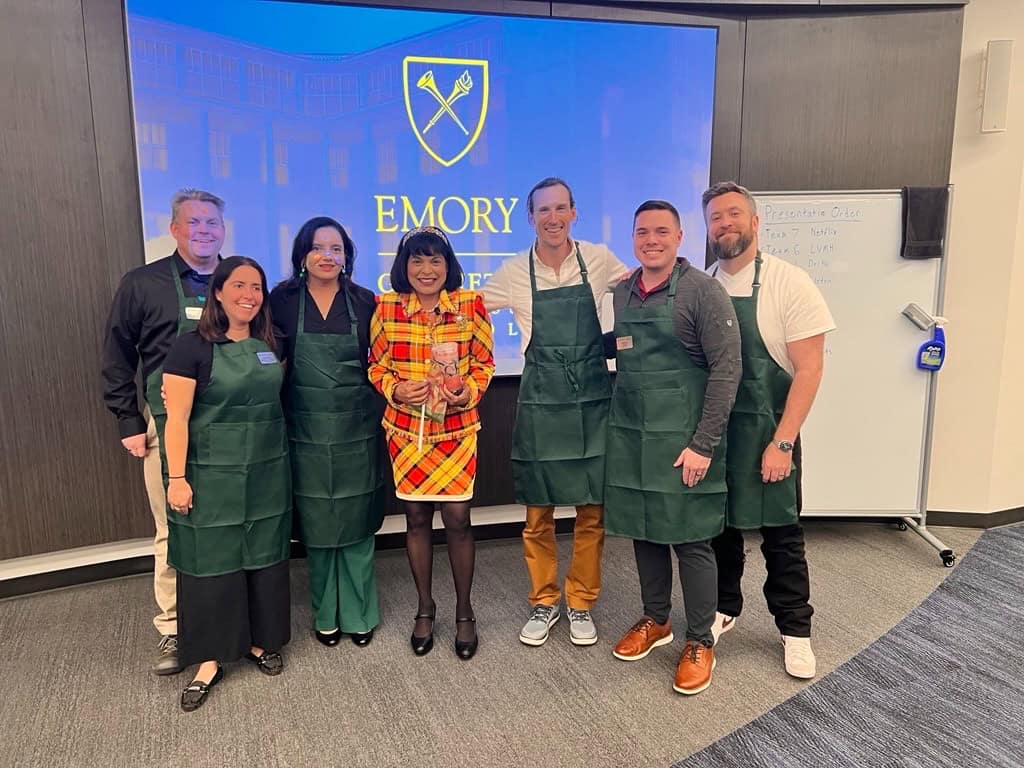
That is the Usha Rackliffe Legacy.
She didn’t just teach us how to read financial statements. She taught us to think like analysts, question like investors, and interpret numbers like storytellers. She took a language I thought I’d lost and made me fluent in it again.
For that, I’m grateful. Grateful she reignited a skill I once had. Grateful she made it relevant to the 2025 economy. And grateful she did it with the style, brilliance, and energy that only Professor Usha Rackliffe can bring to a classroom.
Interested in exploring MBA opportunities? Learn more about Goizueta’s MBA programs.
Read in: 日本語