
CEI Fellow Spotlight: Vidhi Tiwary on Angel Investing and Entrepreneurial Insight
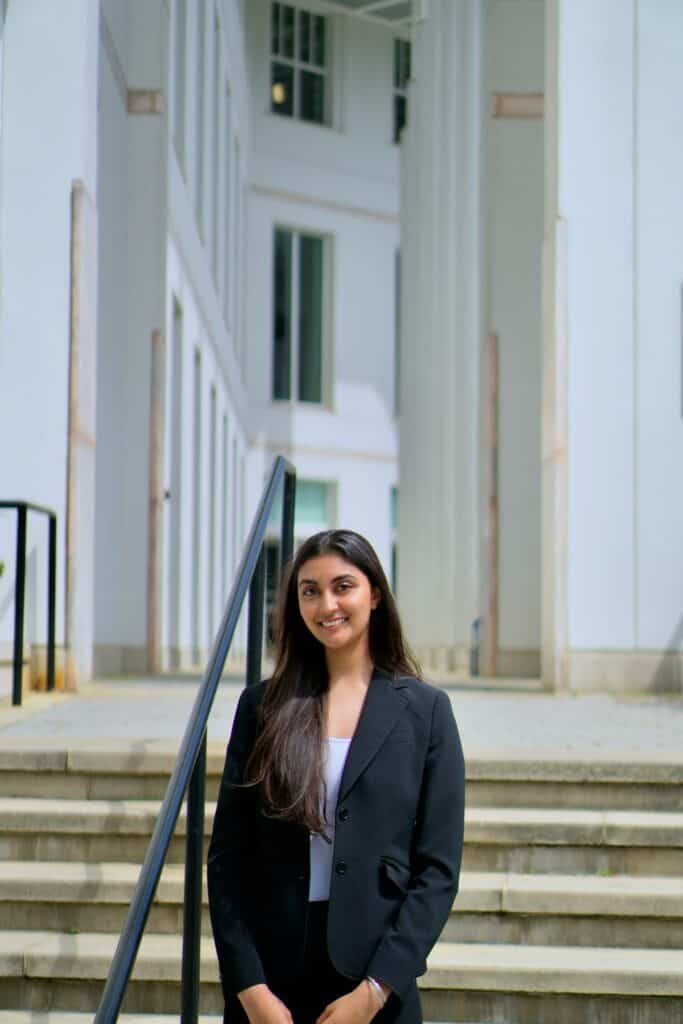
As a CEI Fellow at Goizueta Business School, Vidhi Tiwary 27BBA spent the fall semester gaining firsthand exposure to Atlanta’s entrepreneurial ecosystem through her work with TiE Atlanta Angels. From evaluating early-stage ventures to learning how investors think about risk, growth, and impact, Vidhi’s experience offered a front-row seat to the realities of angel investing.
In this Q&A, Vidhi reflects on what she learned through the fellowship, how the experience shaped her perspective on entrepreneurship and innovation, and how The Roberto C. Goizueta Center for Entrepreneurship & Innovation continues to support students interested in building and backing bold ideas.
To start, can you share a bit about your background and what drew you to the CEI Fellowship at Goizueta?
I’m Vidhi! Growing up, I always enjoyed being curious and having that curiosity in the process of starting things. Whether it was selling slime and slow-rising “squishies” in middle school or co-starting a ticket re-selling brokerage after high school for some quick money, I knew I enjoyed constantly trying new things and getting them across to others. In the midst of recruiting and figuring out how to put my foot in the door in the corporate world, I lost sight of the concepts in business that I am truly passionate about – creation and figuring out how to support that creation. I wanted to be in an atmosphere where I was able to do impactful work on a start-up level, getting that balance of innovation and technical analysis. After a close friend forwarded me the application for the CEI Fellowship, I was happily accepted into the program.
This past fall, you worked closely with TiE Atlanta Angels. What did your role look like, and what types of projects or responsibilities were you involved in?
Working as an Investment Fellow for TiE was an opportunity I am immensely grateful for. Through this role, I was able to gain real time experience and relationships with successful founders and get a fundamental understanding of the macro and micro levels of what makes a successful venture. More specifically, I was paired with different mentors and after finalizing 2-3 startups from a list of 50, we would conduct a deep-dive due diligence analysis to assess whether the Angels should invest in the start-up. This process looked like conducting deep dive market research; what exact industry is it in, how does it differentiate itself, does it utilize any technology that is pioneering and if so, what is the valuation of its intellectual properties?
On a more technical basis, I also had the opportunity to analyze the start-up’s financial statements and understand what can be considered as “red-flags” for start-ups. Getting the ability to see first-hand how successful venture leaders evaluate upcoming start-ups gave me a next-level understanding of what factors make up a start-up that has that next level factor, and I truly believe that this was a skill set that cannot be taught in any course curriculum.
What was one moment, conversation, or experience during the fellowship that really stood out to you or challenged your thinking?
When evaluating over 50+ startups, I remember certain start-ups being rejected despite an extremely high valuation. Because of the TiE Atlanta Angel mentors being extremely encouraging and pushing a drive to embrace curiosity, I felt comfortable asking why such a venture that seemed to have great financial standing as well as a high level of innovation was being rejected by such high level investors. From the TiE team, I was able to learn how high valuation and financial stability is a great profile, but when it comes towards a VC or angel firm perspective, there is a greater focus on exit opportunities, in that sense of how will this venture provide greater returns for investors as a whole. This really opened up my perspective in understanding how to market my own venture as something not only of innovation and profit, but as something with a guaranteed exit for investors.
How did this experience deepen your understanding of entrepreneurship, investing, or early-stage startups—especially beyond what you might learn in the classroom?
This experience completely shifted how I understand entrepreneurship. In class, you analyze ventures after they’ve either succeeded or failed. With TiE, I was looking at companies in real time, when outcomes were still uncertain and decisions actually mattered.
I realized that early-stage investing is so much more nuanced than just strong financials or a large market opportunity. Of course numbers matter, but what stood out to me was how much emphasis investors place on the founder, their adaptability, clarity of vision, and ability to execute under pressure. A pitch deck can look perfect, but if the founder can’t articulate a path to scale or handle tough questions, that becomes a real concern. It also made me much more detail-oriented. Small things, unclear IP ownership, unrealistic projections, and messy cap tables can completely change an investment decision. Watching experienced angels dissect those details showed me that innovation alone isn’t enough. There has to be structure, discipline, and a clear understanding of how value will ultimately be realized.
Overall, it made entrepreneurship feel more real to me. It’s not just about having a bold idea. It’s about building something durable, investable, and scalable, and understanding how every decision impacts long-term growth and exit potential. That level of exposure is something you just can’t replicate in a traditional classroom setting.
In what ways has being a CEI Fellow influenced your academic or career goals moving forward?
Being a CEI Fellow has opened up doors for me that I would not have had otherwise. For example, as someone in the process of starting their own venture, being a CEI fellow gave me a network of angel investors, VC funds, and other entrepreneurs starting their own journey. This network has given me the confidence to proceed with working on my ventures and rely on individuals to give me constructive criticism on how I can improve on my venture. Being a CEI fellow has also given me the ability to gain a comprehensive understanding of high level financial patterns and trends that cannot be replicated through coursework. I am extremely grateful to have been able to find a community at Emory that supports both my passion and growth in creation.
What advice would you give to other Goizueta students who are interested in entrepreneurship, venture capital, or getting involved with CEI opportunities?
Start! Just start! It’s one thing to have an idea and create a vision of that idea in your head, but it’s another thing to start. There are various opportunities Goizueta provides students such as Pitch the Summit, Hatchery’s Summer Accelerator Program, and TechStar Catalyst to name a few. Put yourself out there and be open, opportunities can come when you least expect it.
Explore the resources of The Roberto C. Goizueta Center for Entrepreneurship & Innovation and learn how Goizueta empowers entrepreneurs, innovators, and problem-solvers in a changing world.
Interested in pursuing a business degree? Learn more about the unique programs Goizueta has to offer.
