
From Student to Decision-Maker: Inside a National Investment Competition
Read in:
Goizueta students recently participated in the Venture Capital Investment Competition (VCIC), the world’s largest experiential venture capital competition, where teams step into the role of VCs to evaluate real startups and make investment decisions under pressure.

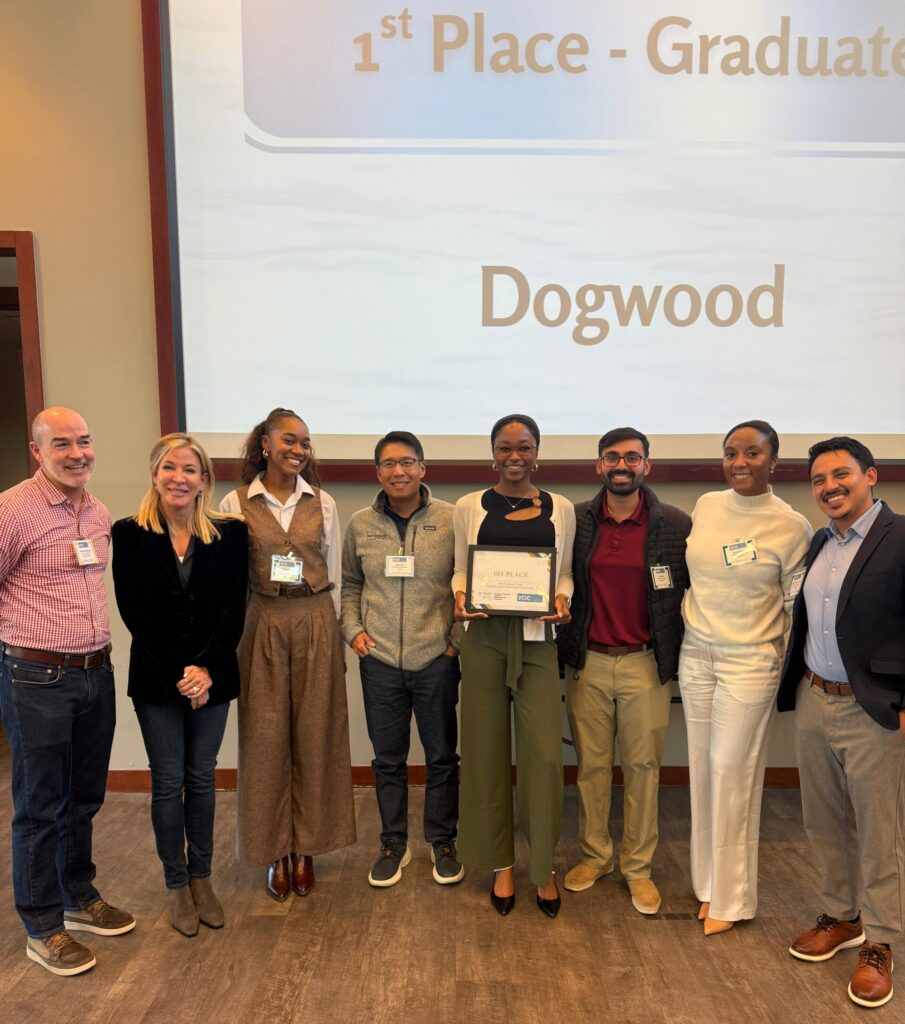
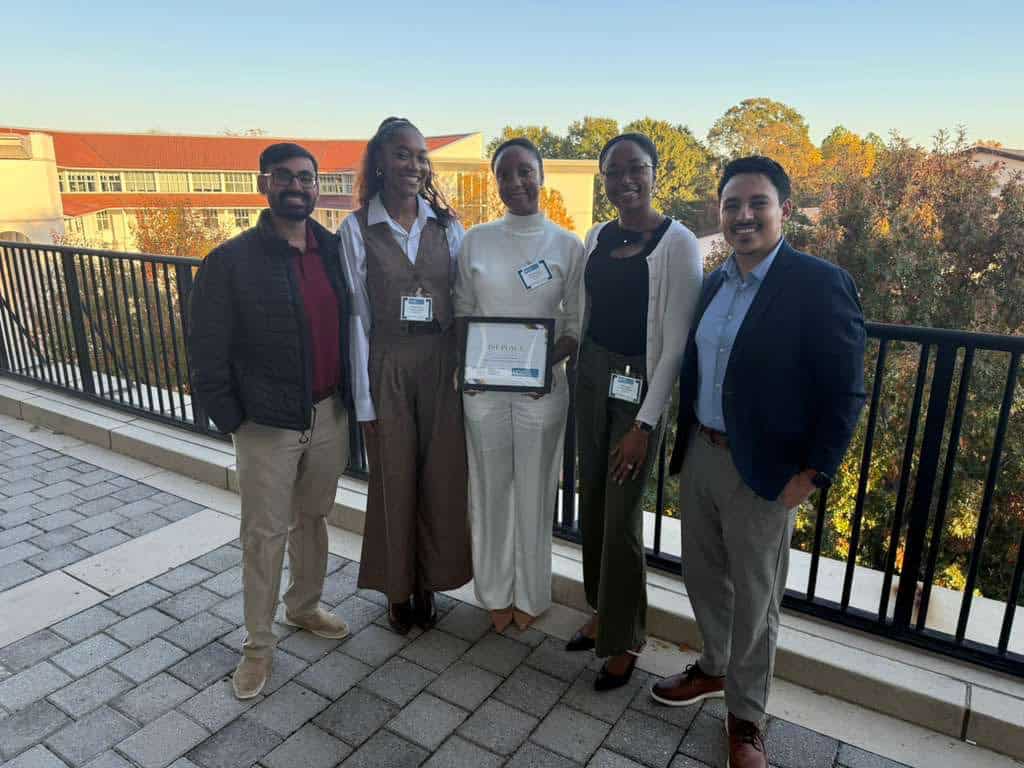
We caught up with Khayla (McCoy) Vickers 28MBA, a fellow for The Roberto C. Goizueta Center for Entrepreneurship & Innovation, and member of the winning MBA team, to hear about her experience, key takeaways, and how the competition shaped her perspective as an emerging investor.
Please tell us about yourself and your role at Goizueta?
I’m an Evening MBA student at Goizueta Business School, Class of 2028. I currently work full time in strategy and analytics at Google, and I came to Goizueta to deepen my decision-making toolkit, particularly at the intersection of data, strategy, and capital allocation.
The Center fellowship was one of the key drivers that drove me to Emory. I’ve always been interested in entrepreneurship and the VC space, so the opportunity to be a fellow was one I couldn’t pass up. Because of my involvement as a fellow, I’m constantly exposed to opportunities like the VCIC competition.
What is the Venture Capital Investment Competition and how did you get involved?
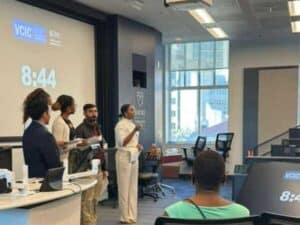
VCIC is a global, experiential competition where student teams step into the role of venture capital investors. Teams evaluate a real startup, conduct diligence under tight time constraints, and ultimately make an investment recommendation to a panel of experienced judges acting as limited partners.
I got involved because VCIC offered exactly the kind of high-pressure, real-world decision-making environment I was looking for. It’s one thing to learn valuation and venture theory in class, but VCIC forces you to apply those frameworks quickly, collaboratively, and with incomplete information, which mirrors real investing.

What was your team’s goal going into the competition, and what problem were you ultimately tasked with solving?
Well, our first goal was to have fun. This is a space all of us have an interest in and curiosity around, so we really wanted to make the most of the opportunity and enjoy ourselves. Secondly, we wanted to make a credible, defensible investment decision, not just a compelling pitch. We wanted judges to feel confident that if this were real capital, we’d done the work to deploy it responsibly.
Ultimately, we were tasked with answering a core VC question: Does this company deserve investment now, at this price, given the risks, market opportunity, and team execution capability? Everything we did flowed from that question.
Can you walk us through your team’s approach to evaluating the investment opportunity?
This team was such a joy to work with because everyone was collaborative, flexible, and thoughtful. Early on, we identified potential strengths that each team member had and who we’d look to for what expertise during the competition. That was good to do early, given we were on tight time constraints once the competition started. From there, we started by grounding ourselves in first principles. We assessed the problem the company was solving, the customer pain point, and whether the solution was meaningfully differentiated.
After that, we evaluated:
- Market size and expansion potential
- Business model scalability and unit economics
- Competitive landscape and defensibility
- The founder and teams’ strengths and execution risk, and the
- Financial assumptions and capital efficiency
We were disciplined about separating signal from story. Every qualitative insight had to tie back to a tangible risk or opportunity, and every financial assumption had to map to a real operational driver.
What role did you play on the team during the competition?
My role, and everyone’s role, really flexed throughout the competition. However, I’d say I mostly leaned into a hybrid role that sat between analysis and narrative. I focused on translating diligence insights into a clear investment story, ensuring our numbers, risks, and recommendations all aligned. I love working with numbers and using frameworks to try to calculate real ROI, so I’m grateful to my team for giving me the opportunity to play that role.
I also helped pressure-test assumptions and kept us anchored to the investor perspective: What would actually matter to an IC making this decision? That lens helped us stay focused and avoid over-engineering the pitch. As someone with former VC and Angel experience, my team trusted me to push back and ask the tough questions.
What made your team’s pitch stand out and ultimately lead to a win?
Our pitch stood out because it felt real. We got a lot of feedback that the assumptions we made were thoughtful and the terms structure we recommended was realistic. We didn’t oversell the company, and we didn’t shy away from risk. Instead, we articulated:
- Why the opportunity was compelling
- Where the risks were (we were thorough here)
- Why those risks were acceptable or manageable at this stage (we spent quite a bit of time here to gain investor buy-in)
Judges could see that we understood not just the upside, but the trade-offs, which built trust in our recommendation.
What was the most challenging part of the competition, and how did your team overcome it?
The biggest challenge was time. You have limited hours to digest a huge amount of information and converge on a single recommendation. On competition day, we ran out of time in every round. After the first round, we decided what served as a minimum viable product for ourselves and committed to get to, at minimum, that MVP in every round following.
Overall, we managed time by being decisive early about priorities and trusting one another’s expertise. We aligned quickly on what mattered most to the investment thesis and avoided getting stuck in analysis paralysis. Strong communication and trust within the team made that possible.
What skills or lessons from the VCIC experience will you carry forward into your career?
VCIC reinforced the importance of:
- Structured decision-making under uncertainty
- Clear communication of complex ideas
- Balancing conviction with intellectual humility
I’ll carry forward the habit of always asking, “What would change my mind?” That mindset is valuable in venture, strategy, and leadership more broadly.
How did Goizueta—through coursework, faculty, or experiential learning—prepare you for this competition?
Goizueta’s emphasis on applied learning was critical. Case-based coursework trained me to analyze ambiguous situations quickly, while faculty consistently pushed us to think like decision-makers, not just students.
The culture also encourages collaboration and debate, which mirrors how real investment teams operate. VCIC felt like a natural extension of the classroom.
What advice would you give to other Goizueta students who are considering participating in VCIC or similar competitions?
Do it, even if you don’t feel “ready.” You don’t need to be a venture expert going in. Most of our team members don’t have venture experience, and for many, this was their first experience with anything like VCIC. You don’t need experience to start; you need curiosity, discipline, and a willingness to learn fast.
Also, focus on the process, not just the outcome. The real value comes from learning how to think like an investor under pressure.
Looking ahead, how has this experience influenced your career interests or goals within venture capital, entrepreneurship, or beyond?
VCIC deepened my interest in roles that sit at the intersection of strategy, capital, and growth. Whether in venture, operating roles, or entrepreneurship, I’m excited by environments where thoughtful capital allocation can shape outcomes.
More broadly, it reaffirmed that I want to work in spaces where rigorous analysis and human judgment are equally valued.
Explore the resources of The Roberto C. Goizueta Center for Entrepreneurship & Innovation and learn how Goizueta empowers entrepreneurs, innovators, and problem-solvers in a changing world.
Interested in exploring Full-Time MBA opportunities? Learn more about Goizueta’s Full-Time MBA program.
Read in:
